Base Unit Lift duct Thrust Duct Motor Mounts Front Cabin
Centre Cabin Air Duct Cover Skirt R/C Installation
Lift Duct
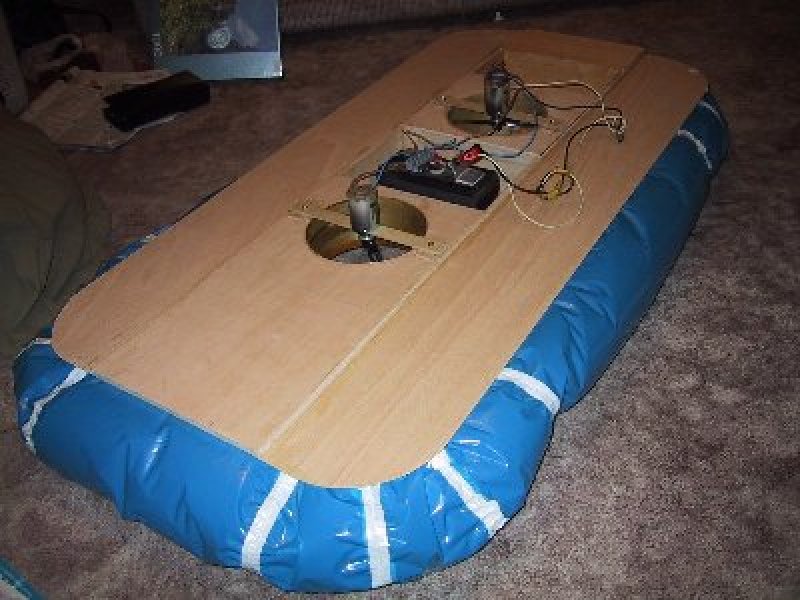
The model was built with two lift ducts, both being identical in size but the forward duct used a single air outlet to the skirt. A flap valve was fitted to each of the air inlets to the skirt. Early experiments showed that this setup was very inefficient at providing lift. The pressure built up by one duct was lost via the other, even though both ducts were running the same size motors and props. The flap valves worked well and the model held a fully inflated skirt for 10-15 Secs. after power was removed. The flap valves were eventually taken off when it was realised that the skirt remained too stiff when running on turbulent water leading to excessive air loss.
Several props were tried as well as multi-blade fans all with different pitches. The multi-blade fans were very effective at lifting weight. One 8 blade fan would lift the model at a weight of 14lbs and sail on water but would not accelerate over the hump..Running over tarmac however was fine and did not drag the skirt at all. The battery pack for these tests was a 4.8 volt 10amp ni-cad which would give a 30 minute running time.
Early experiments with twin lift ducts using polythene for skirt. The lift power is a 12volt 7.5amp/hr lead acid battery.
Multi blade fan mounting
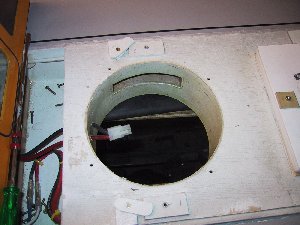
The following photos show the construction of the fan and gearbox mounting unit which fits onto the standard duct of the model. The motor is situated inside the duct with the fan above the duct on it's gearbox (2.9/1) An outer ring extends the duct upwards to shroud the fan. The whole assembly can be removed so that the original direct drive motor can be re fitted.
|
|
|
|
|
|
|
|
 Rear
duct
Rear
duct  Fan blade
angle
Fan blade
angle  Motor mount for gearbox and
fan
Motor mount for gearbox and
fan 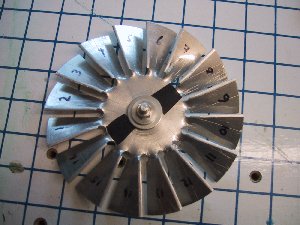 16 Blade fan
  Gearbox mounting
  Outer duct extension for fan
  Completed Fan ready for model
 Fan assembly on model