Inclined Manometer
Designed by Fran Oakey
Download PDF version(click here)
|
|
Firstly,what is a manometer?
It is a device for measuring the pressure of gasses and vapours, and in its simplest form is a vertical glass U tube half filled with water.
A positive pressure applied to one arm of the tube causes the water to move down in that arm and up the other arm, the pressure is the distance between the lower meniscus and the upper meniscus, and is usually measured in inches.
The unit of this pressure is then inches of water . When using a simple U tube type manometer it is necessary to reset the scale zero to the lower meniscus, before taking the reading at the upper meniscus.
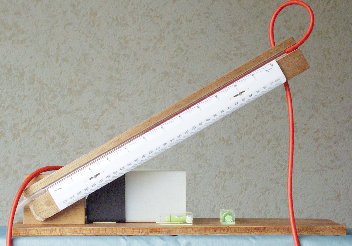
Now to the inclined manometer, shown above, this is just a more complex U tube.
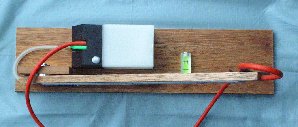
One arm of the instrument is a glass tube in a mount to which is attached a scale, in this case a 12 inch ruler, the other arm is a plastic container, a model aircraft fuel tank. The tank has two connections, one at the bottom, which connects to the lower end of the glass tube, and the other is the pressure connection at the top of the tank.
A pressure applied to the tank causes the water in the tank to be forced up the glass tube and read on the scale. The glass tube/scale assembly can be either vertical, giving a direct reading, or set at an angle to give a scale factor, e.g. set to 30 degrees, the pressure will be the scale reading multiplied by 0.5 (sine 30 degs), thus allowing low pressures to be read more accurately.
The main considerations when designing this instrument were, accuracy, and zero stability, these two parameters are interrelated. When pressure is applied and water rises in the tube, the water in the tank lowers. This means that the zero lowers and the pressure read on the scale is therefore lower than the actual pressure, (by about 0.3% on this instrument, see later).
To minimise this error, the surface area of the water in the tank must be large compared, with the cross sectional area of the tube. The tube inside diameter is 0.187 inches, area 0.02746 sq. in, area of the tank, 4 inches x 2.3 inches, is 9.2 sq. in, this gives an error of 0.298%. This error can be reduced by carefully adjustment to the angle of inclination of the measuring tube/arm. The pivot point of the arm is at the zero point, so that the zero does not change significantly when the angle of inclination is changed.
The scale can be moved up to + or -; 3/8 of an inch, to allow some adjustment, to zero the instrument. Spirit levels are added to check that the instrument is horizontal in both planes before zeroing the instrument and taking readings.
Commercial instruments use a blend of paraffin instead of water and are scaled to allow for the density of paraffin, which is about 0.8. It would be necessary to measure the density accurately if one does use such a liquid, so that the accuracy of the instrument can be maintained.
Algae will grow in water left in the instrument for a long time, to prevent this,the manometer should be drained when not in use.
Uses for this instrument in model Hovercraft are, the measurement of the plenum and bag skirt pressures and air velocity when coupled to a Pitot tube.